
You pour hours, maybe even days, into researching and writing a cornerstone piece of content. You hit publish, build some links, and watch it climb to page one. But fast forward a year, and the traffic is slowly bleeding out.
It’s painful, but it’s a reality every marketer faces: content decay. Competitors publish newer data, search intent shifts, and Google’s algorithms increasingly favor fresh, updated content. Fighting this decay manually is an endless, exhausting grind that drains resources from creating new content.
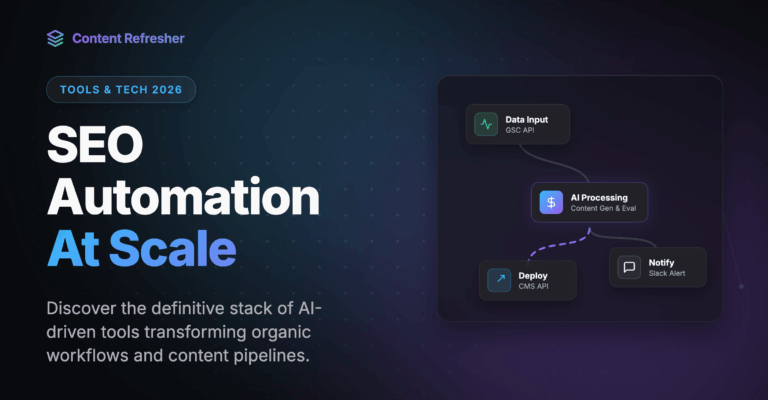
This is where seo automation becomes your team’s most valuable asset. But let’s be candid—handing over the keys to an AI and letting it auto-publish unchecked content to your blog is a recipe for disaster. True automation isn’t about replacing your editorial standards; it’s about scaling your output while keeping your hands firmly on the steering wheel.
In this guide, we’ll explore the top SEO automation tools that help you work smarter, fix content decay, and protect your rankings—all without sacrificing quality.
What is SEO Automation (and What is it Not)?
SEO automation is the process of using software—increasingly powered by artificial intelligence—to handle the repetitive, data-heavy tasks involved in search engine optimization.
Good SEO automation does:
- Monitor your site for technical errors 24/7.
- Identify which posts are losing traffic and need updating.
- Generate data-driven briefs and content drafts instantly.
- Save your team hundreds of hours a month.
Good SEO automation does not:
- Publish unverified AI content directly to your live website.
- Replace human strategy, empathy, or brand voice.
- Function entirely on autopilot without oversight.
Let’s look at the best tools on the market that strike the perfect balance between AI efficiency and human oversight.
Ready to take the next step?
Boost your rankings and stay ahead of the competition with AI-powered content refreshing.
Get StartedTop SEO Automation Tools for Scaling Traffic
1. Content Refresher (Best for Automated Content Decay Prevention)
We might be a bit biased, but when it comes to keeping your existing content catalog fresh, nothing beats a dedicated, human-in-the-loop system. Content Refresher is an AI-powered plugin that detects your outdated WordPress posts and generates refreshed content drafts for your approval — before anything goes live.
If you are running a SaaS company with a content-heavy blog, an in-house SEO team, or a digital agency managing multiple WordPress sites, keeping older posts updated is a massive logistical headache. Content Refresher solves this by automating the heavy lifting while giving you the final say.
How the SEO automation workflow works:
- Automated Scanning: The plugin checks your posts daily and selects those older than your configured threshold (e.g. 6 months).
- AI-Powered Research & Drafting: Each selected post is sent to the Content Refresher API, which uses real-time data and AI to generate a refreshed version.
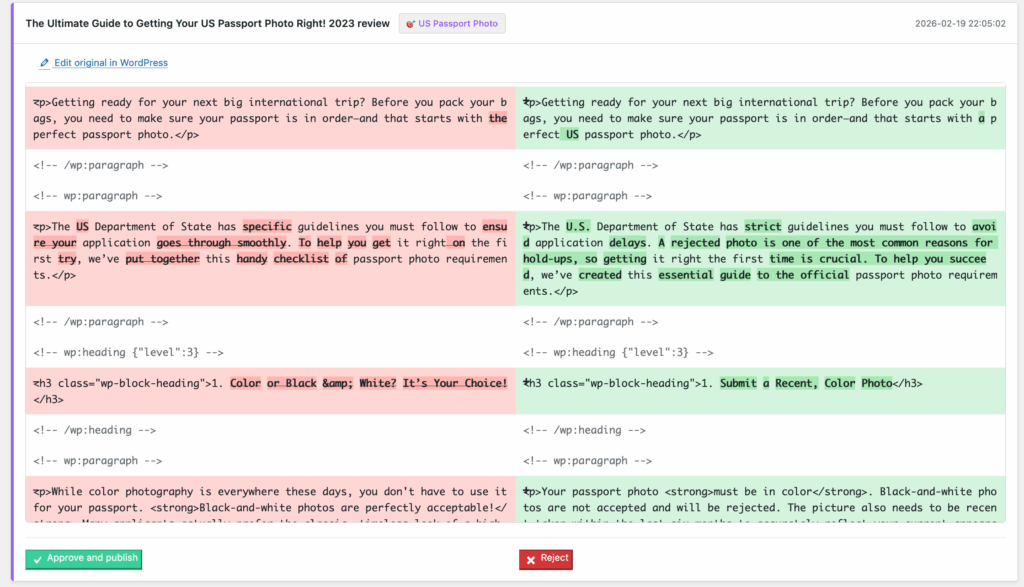
- The Verification Queue: This is the magic step. The new draft appears in the plugin’s Verification Queue, allowing you to review and approve (or reject) each one.
- Safe Publishing: Only approved drafts are applied to your post, meaning you are always in control. Nothing is published without your explicit action.
2. Surfer SEO (Best for On-Page Optimization)
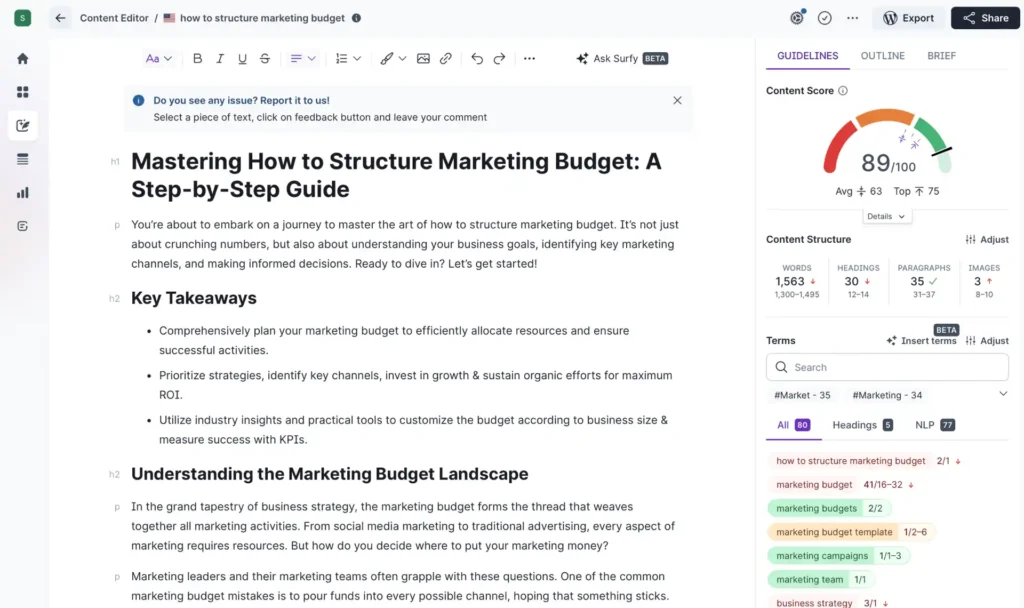
When you are trying to figure out exactly why a competitor is outranking you, doing the math manually is impossible. Surfer SEO automates on-page analysis by evaluating over 500 ranking factors across the top SERP results.
Instead of guessing how many times to use a keyword or how long your article should be, Surfer gives you a real-time, automated “Content Score.” It’s an essential SEO automation tool for ensuring your drafts are mathematically optimized to compete before you hit publish.
3. Ahrefs (Best for Technical & Backlink Automation)
Ahrefs remains a powerhouse for automating the discovery phase of SEO. While it’s famous for keyword research, its automation capabilities shine in site auditing and link monitoring.
You can set Ahrefs to automatically crawl your website weekly, instantly flagging broken links, missing meta tags, and redirect loops. It also automates backlink tracking, sending you alerts when you gain a new high-value link—or when a competitor steals one from you.
4. Clearscope (Best for Semantic SEO & Outlines)
If you are managing a team of freelance writers, ensuring every piece of content hits the right semantic entities can be a bottleneck. Clearscope automates this by analyzing top-ranking pages and generating a comprehensive list of terms your content must include to be considered highly relevant by Google.
It acts as an automated editorial assistant, ensuring your human writers naturally cover the topic comprehensively without resorting to old-school keyword stuffing.
Why the “Human-in-the-Loop” is the Future of SEO Automation
The tools listed above are incredibly powerful, but you’ll notice a common thread: they all require a human to make the final call. In the rush to adopt AI, many marketers make the mistake of setting up fully automated pipelines that churn out and publish content without oversight. This leads to generic, robotic content that hurts your brand trust and is highly vulnerable to Google’s “Helpful Content” algorithm updates.
That is exactly why Content Refresher was built with a strict “human-in-the-loop” philosophy. We believe that seo automation should do the tedious research, the data gathering, and the initial drafting, but a human editor must verify the quality. You stay in full control: nothing is published without your explicit approval.

Ready to Stop Content Decay in its Tracks?
Refreshing old content is one of the highest-ROI activities in SEO, but doing it manually is simply not scalable. By integrating the right SEO automation tools into your workflow, you can breathe new life into your decaying posts, reclaim lost rankings, and free up your team to focus on high-level strategy.
If you manage a content-heavy WordPress site, it’s time to put your content updates on autopilot—safely.
Ready to take the next step?
Boost your rankings and stay ahead of the competition with AI-powered content refreshing.
Get StartedFrequently Asked Questions About SEO Automation Tools
The biggest risk is losing your brand voice and publishing inaccurate information (often called AI “hallucinations”). Fully autonomous systems that publish directly to your CMS without review can quickly tank your rankings if Google deems the content unhelpful or spammy. True automation should scale your workflow, not replace your editorial standards.
It highly depends on your industry and how quickly the information changes. Fast-moving niches like tech or finance might require quarterly updates. However, for most B2B and SaaS blogs, a good rule of thumb is to configure your seo automation tools to flag posts older than a 6-month threshold. If a post is six months old and its organic traffic is starting to plateau or dip, it’s time for a refresh.
No, Google has explicitly stated that it does not penalize AI-generated content inherently. Google’s algorithms penalize poor quality, unhelpful, or mass-produced content, regardless of whether a human or an AI wrote it. Using AI to analyze data, research topics, and draft updates is a smart strategy, provided a human editor ensures the final piece provides genuine value to the reader.
A human-in-the-loop system means that artificial intelligence performs the heavy lifting—like analyzing real-time data and generating a draft —but a human expert must review, refine, and approve the action before it is finalized. This is the safest way to refresh old content. For example, tools like Content Refresher place AI-generated drafts in a Verification Queue. You stay in full control: nothing is published without your explicit approval.

With over 5 years of experience in Technical SEO and automation, Tomasz helps brands scale their organic traffic without scaling their headcount. Drawing from his experience in global tech projects like PhotoAiD, he specializes in Generative Engine Optimization (GEO) and building custom AI tools that eliminate repetitive work. He created Content Refresher to help founders put their content maintenance on autopilot.