
In today’s noisy digital marketplace, technical SEO isn’t just a “nice-to-have”—it’s the secret weapon behind sustainable growth.
Did you know that pages loading in just 1 second experience conversion rates 2.5 times higher than those loading in 5 seconds, and a single architectural flaw can hide your content completely from Google?
As paid acquisition costs rise, brands that invest in technical foundations see far greater returns. In fact, comprehensive data shows SEO delivering an average 8x ROI.
So, whether you are planning a site audit or simply want to understand what drives organic traffic in 2026, these up-to-date technical SEO statistics will help you stay ahead.
Key technical SEO stats
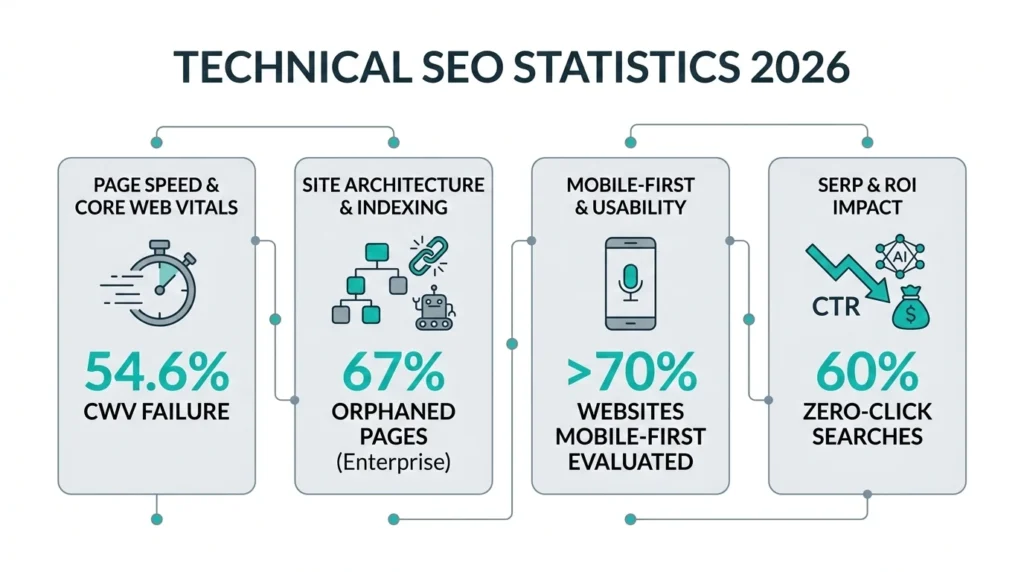
- Roughly 60% of all global search queries now yield zero clicks, terminating the user journey directly on the search results page without transferring traffic to publishers.
- As of the final quarter of 2025, only 54.6% of all active websites successfully meet the overall baseline standards for Core Web Vitals.
- Despite advancements in automated crawling technology, 67% of enterprise and mid-market websites suffer from orphaned pages, effectively rendering massive portions of their content completely invisible to search indexers.
- The integration of AI Overviews (AIOs) at the top of search engine results pages reduces organic click-through rates to standard web properties by 34.5%.
- Search engines officially evaluate over 70% of all global websites exclusively through a mobile-first indexing paradigm.
Page speed & Core Web Vitals
How impatient do you think users really are?
It is to be noted that an estimated 53% of mobile users will entirely abandon a website if the initial load time exceeds 3 seconds.
A fractional 0.1-second improvement in site speed can increase retail conversions by 8.4% and travel sector conversions by 10.1%.
Key Takeaways
- 86% of web pages load in under 5 seconds.
- Websites that achieve an optimal load time of 3.3 seconds reach peak conversion rates averaging 4.75%.
- When analyzing the top 1,000,000 most popular websites, only 36% of mobile versions maintain passing Core Web Vitals, compared to 48% of desktop versions.
The ROI of technical SEO
If you still have doubts about the importance of technical optimization, know that leads generated through organic search engines close at a rate of 14.6%, vastly outperforming outbound marketing leads which close at a marginal 1.7%.
Acquiring traffic organically produces a Cost Per Lead (CPL) of $147, which is drastically more efficient than the $280 CPL generated by paid search equivalents.
- The single top-ranking organic result captures a 39.8% CTR.
- In the highly competitive B2B SaaS sector, rigorous SEO execution demonstrates an average ROI of 702% over a standard three-year measurement window.
- Organic traffic is responsible for capturing 53% of all trackable digital traffic routed to global websites.
The impact of AI on SEO
Are you implementing schema markup? It turns out that structured data feeds today’s large language models.
Data suggests that 76% of links cited within AI Overviews are pulled directly from URLs that already rank in the top 10 traditional organic results.
Key Takeaways
- A concerning 26% of established digital brands have zero mentions or citations within Google’s AI Overviews.
- AI bots rely on baseline hygiene schemas; 82% of pages cited by AI utilize standard Organisation markup, and 76% utilize WebPage/Article schema.
Challenges in technical SEO
Yes, maintaining flawless site architecture is more challenging for businesses than ever before.
- A notable 23% of active websites fail to provide a link to their XML sitemap within their foundational robots.txt file.
- Internal 4XX broken links and infinite redirect loops plague 45% of analyzed websites.
- Among domains attempting internationalization, a massive 67% suffer from hreflang configuration errors, destroying localization efforts.
- Rising expectations: Users want speed. If a page requires an additional 2 seconds of loading time beyond optimal thresholds, the bounce rate increases by an astounding 103%.
Best practices to build long-lasting search visibility
What’s working today? Let’s look at the best practices brands are using:
- Start with Mobile-First. With mobile devices responsible for 64.17% of all worldwide internet traffic, ensure flawless rendering on smartphones.
- Fix internal linking. Eliminate orphaned pages to allow search engine crawlers to efficiently parse your content.
- Optimize JavaScript. Ensure that delayed script loading does not block your Largest Contentful Paint (LCP).
- Implement baseline structured data. Focus on Organisation and Article schema to increase your chances of appearing in AI-driven search results.
Conclusion
In 2026, SEO goes beyond just keywords and links. It’s rooted in lightning-fast load times, flawless information architecture, and alignment with AI engines. As search engines become more demanding, technical foundations are the only guarantee of survival.
Whether you are optimizing an existing site or starting from scratch, these statistics offer a blueprint for what works in the digital landscape today.
FAQs
Currently, roughly 45.4% of all websites fail to meet the baseline parameters for Google’s Core Web Vitals. Only 54.6% of websites maintain passing scores across all metrics.
Recent data indicates that nearly 60% of all search queries yield no clicks to external websites. Furthermore, the presence of AI Overviews reduces organic click-through rates to standard web properties by an average of 34.5%.
Yes, the financial impact is severe. A one-second delay in mobile load times can cause up to a 20% drop in overall conversion rates. An estimated 53% of mobile users will abandon a website entirely if it takes longer than 3 seconds to render.
The most prevalent errors include orphaned pages lacking internal links (67%) and broken internal links or redirect chains (45%).
Sources:
- https://ahrefs.com/blog/b2b-seo-statistics/
- https://seranking.com/blog/seo-statistics/
- https://searchatlas.com/blog/seo-statistics/
- https://www.semrush.com/blog/ai-seo-statistics/
- https://ketan-kumar.medium.com/top-10-seo-issues-with-solutions-2025-complete-guide-0fe45420daf3
- https://www.wearetenet.com/blog/website-speed-page-load-time-statistics
- https://www.wordstream.com/blog/conversion-rate-optimization-statistics
- https://wp-rocket.me/blog/website-load-time-speed-statistics/
- https://www.incremys.com/en/resources/blog/seo-statistics
- https://almanac.httparchive.org/en/2024/performance
- https://www.nostra.ai/blogs-collection/everything-you-need-to-know-about-googles-mobile-first-indexing
- https://www.semrush.com/blog/google-search-statistics/
- https://www.pageoptimizer.pro/blog/technical-seo-statistics-that-you-must-know-in-2025
- https://backlinko.com/seo-stats
- https://www.forbes.com/advisor/business/software/website-statistics/
- https://almanac.httparchive.org/en/2025/seo
- https://almanac.httparchive.org/en/2024/seo
- https://almanac.httparchive.org/en/2024/seo#hreflang
- https://sitebulb.com/javascript-seo/report/survey-results/understanding-js-seo/
- https://www.clickrank.ai/javascript-rendering-affect-seo/
- https://almanac.httparchive.org/en/2025/security
- https://www.semrush.com/blog/semrush-ai-overviews-study/
- https://www.wordstream.com/blog/seo-statistics
- https://searchengineland.com/top-seo-news-stories-2025-466726
- https://almanac.httparchive.org/en/2024/structured-data
- https://www.impressiondigital.com/blog/september-2025-google-algorithm-and-search-industry-updates/
- https://uptek.com/shopify-statistics/vs-magento/
- https://almanac.httparchive.org/en/2025/cms
- https://qualimero.com/en/blog/shopify-vs-magento-comparison-2025-ai-readiness-guide
- https://www.webfx.com/seo/statistics/
- https://seoprofy.com/blog/seo-statistics/

With over 5 years of experience in Technical SEO and automation, Tomasz helps brands scale their organic traffic without scaling their headcount. Drawing from his experience in global tech projects like PhotoAiD, he specializes in Generative Engine Optimization (GEO) and building custom AI tools that eliminate repetitive work. He created Content Refresher to help founders put their content maintenance on autopilot.