
Watching your top-performing blog posts slowly lose organic traffic over time is incredibly frustrating. Content decay is a natural part of SEO, but fighting it requires a strategic approach. While deciding to refresh old content is one of the highest-ROI activities for SEO and content teams, doing it wrong can actually waste your time, stall your rankings, or even harm your site’s performance.
Today, many marketers try to solve this by letting fully autonomous AI tools blindly rewrite their entire blogs. This is a dangerous game. A content refresh most often fails when it’s superficial, misaligned with current intent, or done without considering cannibalization, pruning, and measurement.
If you want to protect your traffic, leverage AI safely, and climb back to the top of the SERPs, here are the biggest traps to avoid.
Key Takeaways: How to Truly Fix Content Decay
- Go beyond the surface: Simply changing dates or adding filler words won’t recover lost rankings. You must match the current search intent, update core data, and provide real value.
- Never let AI publish blindly: Auto-publishing AI content can destroy your SEO. Use AI to do the heavy lifting of research and drafting, but always use a human-in-the-loop process to review and approve the final text.
- More isn’t always better: Don’t refresh blindly. Sometimes the best strategy is actually pruning, merging, or redirecting weak pages to fix keyword cannibalization and site bloat.
Only “Freshening” Dates and a Few Words
Simply changing “2023” to “2026,” bumping the publish date, or tweaking a few sentences without real improvements is a classic empty refresh. Search engines recognize that examples, data, and structure are still outdated, so engagement and rankings usually don’t move. True refreshes require depth.
Adding Words Without Fixing the Core (The “Bad AI” Trap)
Turning a 1 200‑word article into 1 800 words but keeping outdated assumptions, weak sections, or mismatched intent just makes the page longer and less focused. Length alone doesn’t win; updated relevance, clarity, and topical coverage do.
This is the biggest mistake made by teams using fully autonomous AI writers. Google is very clear that simply spinning text adds no value. When discussing sites trying to recover traffic by blindly rewriting pages, Google’s John Mueller stated:
“I wouldn’t think about it as AI or not, but about the value that the site adds to the web. Just rewriting AI content by a human won’t change that, it won’t make it authentic.” — (Read the full discussion on Search Engine Journal)
This is why a human-in-the-loop approach is mandatory. AI should draft the update, but a human expert must ensure the core value and authenticity are actually improved before hitting publish.
Ignoring Current SERP and Search Intent
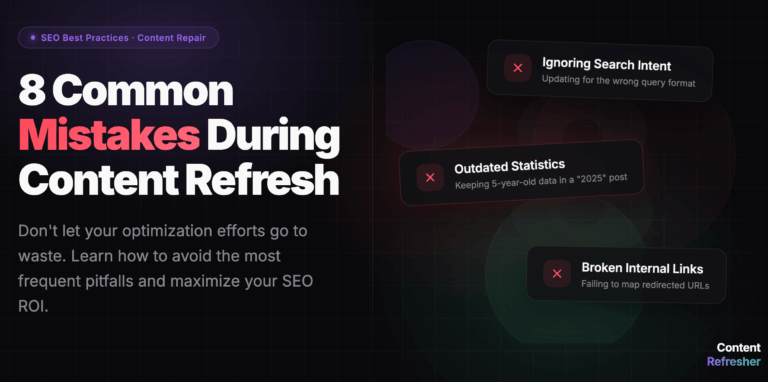
Refreshing in a vacuum—without re‑checking the SERP, new competitor formats, and how intent may have shifted—means you often “optimize” for an intent Google no longer rewards. You miss new required elements (FAQs, step‑by‑step how‑to, tools, data) that top competitors now include.
Creating Content Cannibalization
Updating several overlapping articles on the same topic without keyword/topic mapping can worsen cannibalization, where your own pages compete for the same queries. Instead of multiple refreshed posts on the same keyword, you often need one consolidated pillar plus clearly scoped support articles, with redirects from merged URLs.
Ready to take the next step?
Boost your rankings and stay ahead of the competition with AI-powered content refreshing.
Get StartedRefreshing When You Should Prune
Treating every weak URL as “refresh” material bloats the site and wastes effort on content that should be deleted, merged, or de‑indexed. Low‑quality, irrelevant, or dead‑traffic posts are usually better candidates for pruning or consolidation, while already strong, stable performers often only need light, careful updates or none at all.
However, don’t just let an automated script delete pages based on low traffic. As John Mueller noted:
“It is up to you to decide which of your old content is helpful and useful – it is not up to Google to decide that. (…) Something can be useful even if only a few people read it. Imagine if Wikipedia deleted all articles that were in the lower percentile of views.” — (Read the original context on SERoundtable)
Deleting Critical Content or Breaking URLs
During a refresh it’s easy to accidentally remove sections that answer key queries, hold important keyword clusters, or earn links and conversions. Fully automated AI tools are notorious for accidentally stripping out high-converting paragraphs or breaking formatting.
Furthermore, changing URLs, merging posts, or pruning content without proper 301s and internal link updates throws away equity and creates crawl/indexing issues. If you are simply updating an article, keep the URL intact. John Mueller explicitly advises:
“TBH I’d just replace the content on the existing URL. Changing URLs adds unnecessary complexity in most cases (and adds uncertainty of canonicalization – which URL is chosen).” — (See the full quote on SERoundtable)
Not Updating Data, Examples, and References
Many “refreshes” forget to replace outdated stats, screenshots, tools, and case studies, even though those are often the first things that make content feel old to users. Old numbers and dead tools undermine trust and can signal staleness even if the text was lightly revised.
Ignoring Decay Signals and Failing to Measure
Refreshing randomly instead of using decay signals—traffic drops, ranking declines, or engagement loss—wastes cycles on pages that don’t need work while decayed assets keep sliding. Older content often loses 30–40 % of organic traffic over 12–18 months without maintenance, so refresh cycles should be prioritized by performance data, not gut feel.
Many teams update dozens of URLs without setting baselines or tracking post‑refresh performance, so they never learn what actually worked. At minimum, you should log what changed and monitor rankings, traffic, and conversions per URL so your refresh playbook becomes more effective over time.
The Solution: Automate the Heavy Lifting, Keep the Human Control
Avoiding these common mistakes during content refresh requires deep research, careful writing, and constant monitoring. For SaaS companies, digital agencies, and in-house teams, doing this manually across hundreds of posts is nearly impossible to scale.
But as we’ve established, letting fully autonomous AI rewrite and publish your content is a massive SEO risk.
That is why we built Content Refresher.
Content Refresher automatically identifies blog posts that have become stale and uses AI to generate updated drafts. We combine the power of AI with the safety of a human-in-the-loop workflow.
Here is how it revolutionizes your content maintenance:
- Automated Scanning: The plugin checks your posts daily and selects those older than your configured threshold.
- Deep AI Research: Each selected post is sent to the Content Refresher API, which uses real-time data and AI to generate a refreshed version. This is powered by Google Gemini AI and deep research integration via Tavily API to ensure facts and data are updated.
- The “Human-in-the-Loop” Verification Queue: You stay in full control. The new draft appears in the plugin’s Verification Queue. You review, tweak, and approve (or reject) each one.
- Absolute Safety: Nothing is published without your explicit action. Only approved drafts are applied to your post.
Stop wasting hours manually rewriting outdated blog posts, and stop risking your SEO equity with blind AI writers. Get the best of both worlds: AI speed with human quality control.
Frequently Asked Questions
You should prioritize refresh cycles based on performance data—like traffic drops or ranking declines—rather than just guessing. Older content often loses 30–40% of its organic traffic over 12–18 months without maintenance.
No. Simply bumping the publish date or tweaking a few sentences without making real improvements is an empty refresh. Search engines recognize that the core data and structure are still outdated, so your rankings usually won’t improve.
Absolutely not. Nothing is published without your explicit action. The plugin generates updated drafts that sit in a Verification Queue, and content is only updated after you manually approve it.
It happens when you have multiple overlapping articles on your site competing for the exact same search queries. Instead of refreshing all of them, you should usually consolidate them into one strong pillar post and redirect the old URLs.
Not necessarily. While low-quality or irrelevant posts are good candidates for pruning or consolidation, Google advises that a post can still be useful even if only a few people read it. Prune based on relevance and quality, not just raw traffic volume.
The plugin checks your posts daily and automatically selects those that are older than your configured age threshold (e.g., 6 months). It then uses real-time data and AI to generate a refreshed version for you to review.

With over 5 years of experience in Technical SEO and automation, Tomasz helps brands scale their organic traffic without scaling their headcount. Drawing from his experience in global tech projects like PhotoAiD, he specializes in Generative Engine Optimization (GEO) and building custom AI tools that eliminate repetitive work. He created Content Refresher to help founders put their content maintenance on autopilot.