
To truly understand the modern digital landscape, you have to look at the numbers that are keeping CTOs and CMOs awake at night.
How fragmented is your current tech stack?
The operational reality for most brands is chaotic. These five statistics completely challenge conventional technological wisdom and highlight the severe financial liabilities involved in digital experience management today.
Key CMS Statistics
- The Cloud Failure Epidemic: A massive 33% of all enterprise cloud migration projects fail outright. Even worse, 75% of these projects significantly exceed their planned budgets, resulting in over $100 billion in unexpected global spending.
- The Multi-CMS Paradox: Currently, 61% of enterprise teams are forced to juggle two or more completely separate CMS platforms just to manage their brand’s content. Furthermore, 44% require multiple systems just to achieve basic omnichannel capabilities.
- The Security Avalanche: In 2024, security researchers published 8,223 new vulnerabilities for the WordPress ecosystem—a 68% year-over-year increase. Shockingly, 96% of these vulnerabilities were located in third-party plugins, not the core software.
- The Speed Penalty: Online businesses lose an estimated $2.6 billion in revenue annually entirely due to slow loading speeds driven by bloated CMS architectures. A two-second delay increases e-commerce shopping cart abandonment to a devastating 87%.
- The Cost of Downtime: For 98% of organizations, a single hour of downtime costs over $100,000. At the enterprise level, 41% of large companies report hourly downtime costs fluctuating between $1 million and $5 million.
The Hidden Financial Cost of Legacy CMS
The consequences of ignoring CMS modernization are no longer just theoretical IT debates. They are concrete liabilities actively bleeding corporate balance sheets.
When your digital properties go offline, the financial bleeding is instantaneous.
But exactly how much is a poor digital experience costing you?
Key takeaways (Financial Costs)
- General IT Downtime: The average cost of IT downtime is calculated at $5,600 per minute, equating to roughly $336,000 per hour.
- Retail Catastrophes: In the retail and e-commerce sectors, a downed CMS effectively locks the global storefront, resulting in an average loss of $1.1 million per hour.
- Malicious Traffic: In 2024, Web Application Firewalls blocked over 54 billion malicious requests targeting WordPress sites.
- The Cost of a Breach: The global average cost of a successful data breach stood at $4.44 million in 2025. In the United States, this figure surged to an all-time regional high of $10.22 million.
- UX Abandonment: As of 2025, 53% of users will entirely abandon a mobile page if the load time exceeds three seconds.
- Internal Friction: A massive 84% of enterprise tech leaders explicitly state their current CMS is actively keeping them from unlocking the full value of their content. On legacy platforms, 49% of users report that publishing content takes over an hour.
Table 1: The Hourly Cost of CMS Downtime by Industry
| Industry | Average Loss Per Hour of Downtime |
| General Business | $336,000 |
| Micro-SMBs | $100,000 |
| Retail & E-commerce | $1,100,000 |
| Telecommunications | $2,000,000 |
| Automotive | $3,000,000 |
| Brokerage & Trading | $6,480,000 |
The Massive ROI of Headless & Composable Architecture
To counteract the negative impacts of legacy systems, agile enterprises are rapidly adopting MACH architectures (Microservices, API-first, Cloud-native SaaS, and Headless).
By decoupling the backend from the frontend, brands gain the agility to orchestrate true omnichannel experiences.
And the return on investment? It’s immediate and highly measurable.
Key takeaways (ROI)
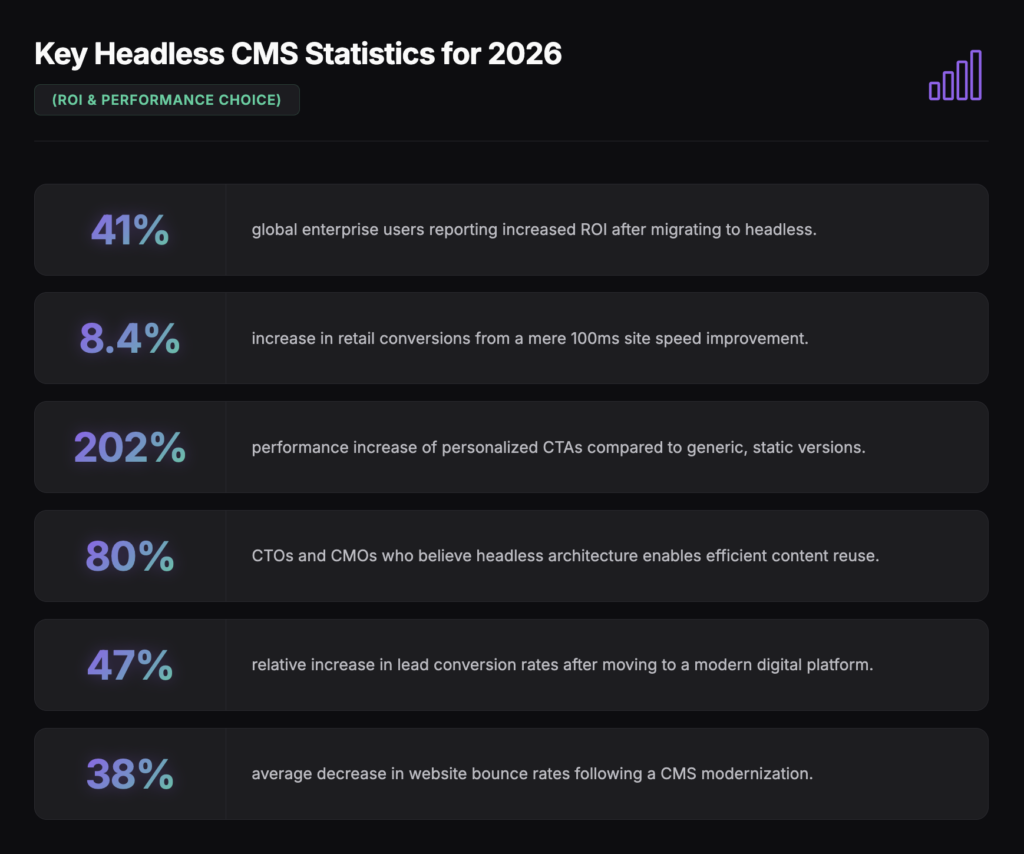
- Headless ROI Triumphs: On a global scale, 41% of enterprise users who migrated to a headless CMS reported a highly measurable increase in overall ROI. In the Netherlands, an astounding 86% of headless users reported increased ROI.
- Content Reusability: 80% of CTOs and CMOs believe headless architecture enables highly efficient content reuse across multiple distribution channels.
- The Speed Premium: A mere 0.1-second (100-millisecond) improvement in mobile site speed directly drives an 8.4% increase in conversion rates for retail websites. Websites that achieve a 1-second load time boast conversion rates up to 2.5 times higher than sites that take 5 seconds.
- Hyper-Personalization Profits: Fast-growing companies generate 40% more of their total revenue from personalized interactions than slower competitors. When experiences are personalized, 80% of businesses report an average order value (AOV) increase of 38%.
- Call-To-Action Dominance: Personalized CTAs dramatically outperform generic, static versions by an incredible 202%.
- Redesign Success: Moving to a modern digital platform increases average lead conversion rates from 2.3% to 3.4%—a massive 47% relative increase. It also drives bounce rates down by 38%.
CMS Market Share & 2026 Adoption Benchmarks
The entire content management ecosystem is expanding rapidly, but the way budgets are being allocated is shifting dramatically.
Are you keeping pace with your competitors?
Key takeaways (CMS Market Share)
- Macro Market Growth: In 2025, the global CMS market size was valued at $34.94 billion and is projected to reach $77.77 billion by 2033, expanding at a 10.6% CAGR.
- The Headless Explosion: The global headless CMS market is forecast to expand at an aggressive long-term CAGR of 22% to 23%, more than double the standard industry pace.
- Current Usage: Approximately 68.7% of all live websites actively use a recognized CMS.
- WordPress Dominance: WordPress remains the undisputed titan of raw volume, powering *43.6% of the entire internet and commanding up to a 68% share of the recognized CMS market.
- Shopify’s Rise: In the e-commerce sector, Shopify expanded its CMS market share from just 1.0% in 2016 to 6.7% in 2025.
- Enterprise Headless Adoption: A massive 73% of all surveyed mid-market and enterprise businesses are currently utilizing some form of headless website architecture.
- The CMO Mandate: Interestingly, 75% of Chief Marketing Officers (CMOs) report using a headless approach, compared to only 65% of CTOs.
- Implementation Costs: Complete enterprise implementations of headless systems typically require total project investments ranging from $75,000 to over $200,000.
Table 2: Global Headless CMS Adoption by Region (2025)
| Region | Enterprise Headless Adoption Rate |
| United Kingdom | 85% |
| Australia | 72% |
| United States | 68% |
The Future: AI, Agents, and B2R Marketing
As we push deeper into 2026, AI is no longer just an experimental novelty. It is now deeply embedded into the operational workflows of modern Digital Experience Platforms (DXPs).
The market is shifting from using AI to simply generate text, to utilizing AI to act autonomously.
Key takeaways (AI)
- Generative AI Usage: Currently, 80% of marketing professionals actively use AI for written content creation, and 75% utilize it for advanced media production.
- Workflow Efficiency: Marketing teams report a massive 50% average reduction in total campaign creation time when utilizing generative AI tools.
- Sales Acceleration: For early adopters, 84% of sales and marketing professionals using generative AI stated it actively helped increase overall sales.
- The Dawn of Agentic AI: 23% of organizations are already actively scaling an agentic AI system somewhere within their enterprise architecture. An additional 39% are actively experimenting in isolated pilots.
- B2R Marketing: By 2026, CMS platforms must be technically optimized for Business-to-Robot (B2R) marketing—serving structured data directly to AI chatbots and LLMs.
- Shifting Budgets: Fully 45% of surveyed marketing leaders are prioritizing their primary budgets for AI-powered marketing tools, decisively beating out traditional owned media (32%) and paid advertising (25%).
- The Execution Gap: Despite these investments, only 18% of marketers say AI has actually reduced their reliance on developers. True AI readiness requires a composable CMS foundation.
Best Practices for CMS Modernization
Based on this exhaustive 2025-2026 statistical data, here are the most critical, actionable steps you can take to future-proof your digital presence:
- Audit Your Technical Debt: If your team is using two or more CMS platforms just to manage basic omnichannel content, you are bleeding operational efficiency. Consolidate via an API-first approach.
- Shift to Composable Architecture: Legacy systems are crumbling under the weight of security vulnerabilities. Transition to a headless CMS to reduce your attack surface and capture the lucrative “speed premium.”
- Prepare for B2R (Business-to-Robot) Interactions: Stop optimizing purely for human eyes. Structure your content natively as modular data via APIs so that autonomous AI agents and LLMs can easily scrape and rank your answers.
- Invest in Personalization: With personalized CTAs outperforming generic ones by 202%, integrating a Customer Data Platform (CDP) with your headless CMS is no longer optional—it’s your primary revenue lever.
Conclusion
The enterprise digital landscape is navigating a macroscopic architectural shift. The data overwhelmingly proves that maintaining legacy, monolithic infrastructure is an unsustainable financial liability. Moving forward, the strategic transition to headless, composable ecosystems is the only proven method to mitigate downtime, drastically improve page speed, and unlock the hyper-personalized, AI-driven experiences that modern consumers demand. To survive the incoming era of Business-to-Robot interactions, you must retire your technical debt today.
FAQs
Across general business sectors, IT downtime costs an average of $5,600 per minute (or $336,000 per hour). However, for enterprise retail and e-commerce companies, a downed CMS results in an average loss of $1.1 million per hour.
Enterprises are migrating to headless architectures to improve site speed, boost security, and increase operational agility. Data shows that 41% of users globally report a highly measurable increase in their overall ROI after migrating from a monolithic platform to a headless CMS.
While enterprise SaaS licensing for headless platforms ranges from $9,000 to $29,000 annually, complete mid-market and enterprise implementations (including front-end development, API orchestration, and hosting) typically require total project investments between $75,000 and $200,000+.
AI is shifting from a simple text-generation tool to an autonomous operational layer. By 2026, CMS platforms must be optimized for Business-to-Robot (B2R) marketing, where structured data is served directly to AI chatbots and autonomous purchasing agents via fast APIs.
Sources:
- www.instaclustr.com
- www.storyblok.com
- www.wordfence.com
- www.sitebuilderreport.com
- www.kanukadigital.com
- siteqwality.com
- mev.com
- www.varonis.com
- hygraph.com
- www.storyblok.com
- wpengine.com
- www.brainvire.com
- www.contentful.com
- www.newperspectivestudio.co.za
- www.grandviewresearch.com
- medium.com
- diviflash.com
- www.rwit.io
- www.hubspot.com
- elfsight.com
- www.salesforce.com
- www.mckinsey.com
- dotdigital.com
- contentmarketinginstitute.com
- cdn.theatlantic.com
- www.webstacks.com
- www.encomputers.com

With over 5 years of experience in Technical SEO and automation, Tomasz helps brands scale their organic traffic without scaling their headcount. Drawing from his experience in global tech projects like PhotoAiD, he specializes in Generative Engine Optimization (GEO) and building custom AI tools that eliminate repetitive work. He created Content Refresher to help founders put their content maintenance on autopilot.