

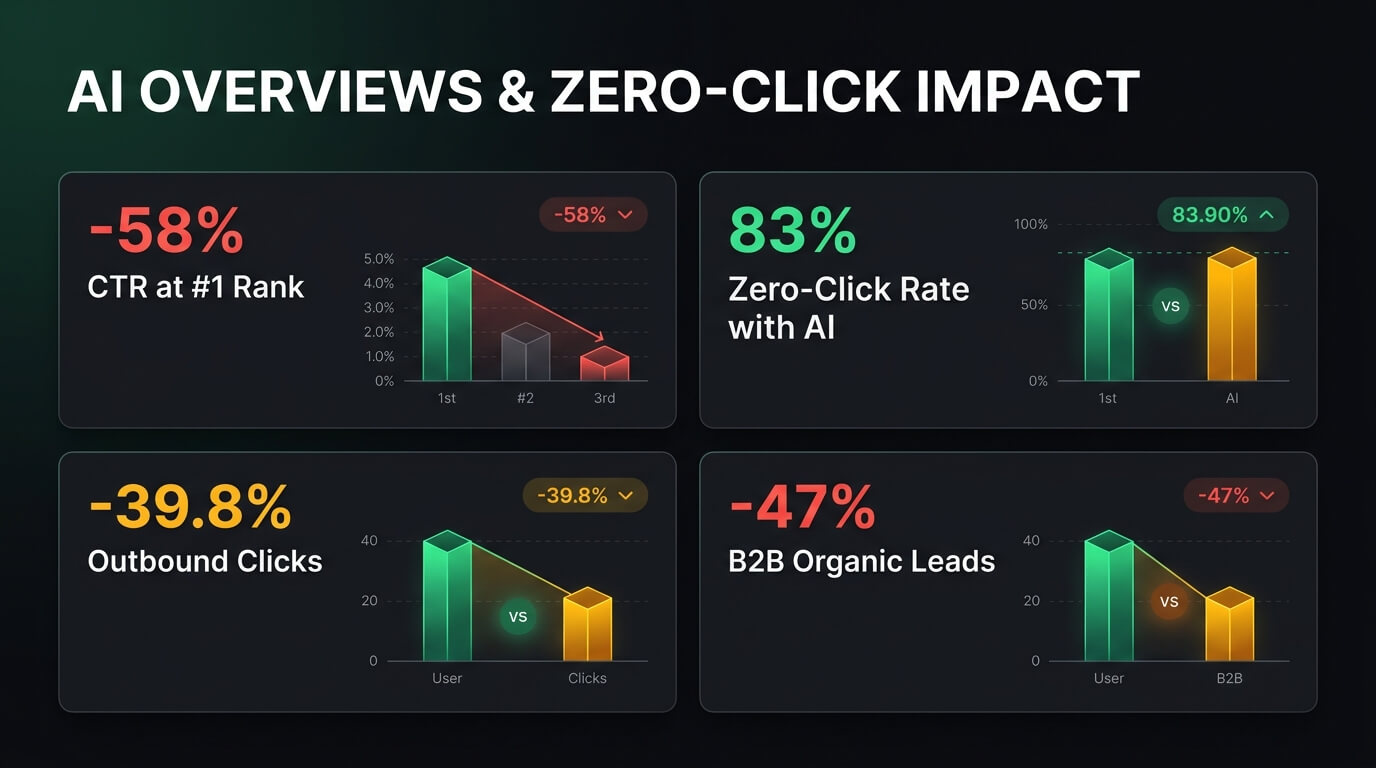
The traditional Google search results page has officially ceased to exist. Outbound organic clicks have plummeted by 39.8% on queries displaying AI Overviews, while the zero-click search rate in the United States has surged to an unprecedented 68.01%. If your search marketing playbook still treats the “ten blue links” as the primary battleground, you are optimizing for a ghost town.
How much of your organic pipeline has already evaporated without you noticing? In this data-backed intelligence report, we analyze over 50 verified empirical benchmarks covering Google AI Overviews, conversational search dynamics, zero-click behavior, and Generative Engine Optimization (GEO) tactics that dictate who wins visibility in 2026.
Key AI Search & Zero-Click Statistics (2026)
- The US zero-click search rate has reached 68.01%, with specific AI Overview queries triggering an 83.0% zero-click rate.
- Securing rank #1 in organic search suffers a 58.0% CTR collapse when an AI Overview occupies position zero.
- 83.0% of domains cited inside Google AI Overviews do NOT rank in the traditional top 10 organic results.
- Expert quotations (+41.0%) and hard statistics (+38.0%) deliver the largest ranking boosts in AI search algorithms.
- Content updated within the trailing 30 days receives a 3.2x higher AI citation frequency than stagnant pages.
Top 5 Most Shocking AI Search Statistics
Is your organic search strategy built on assumptions that expired six months ago?
The speed at which search engines have shifted from digital indexers to sovereign answer engines has caught even veteran SEOs off guard. Google is no longer merely directing users to external websites; it is synthesizing their information, resolving informational intent on the SERP, and keeping the click within its walled garden.
- Outbound organic clicks decline by 39.8%: When a Google AI Overview is triggered, outbound clicks to the open web collapse from an average of 0.61 to 0.38 per query (Carnegie Mellon University & ISB).
- The zero-click baseline hits 68.01%: Less than 36% of all Google searches in the US now produce a click to an external, independent website (SparkToro & Similarweb).
- AI Overviews inflate zero-click behavior to 83.0%: For searches where generative answers actively populate, more than 8 out of 10 users never leave Google (Bain & Company).
- The #1 organic rank loses 58.0% of its CTR: Winning the top organic position used to guarantee double-digit click-through rates; with an AI Overview at position zero, that CTR drops by more than half (Ahrefs).
- 83.0% of cited domains are not in the top 10: Generative models favor authoritative, topically fresh citations over legacy backlink-heavy rankings, decoupling search visibility from traditional SERP positions (BrightEdge).
The Zero-Click Reality: How AI Overviews Are Depressing Organic CTR
What happens to your business when ranking on page one no longer delivers traffic?
For two decades, the entire organic search industry operated on a simple value exchange: web publishers provided free, high-value information, and Google rewarded them with qualified referral traffic. That economic contract has fundamentally fractured. In 2026, Google captures the value while withholding the referral.
The damage is particularly severe across B2B lead generation. Studies tracking organic enterprise pipelines reported a 47.0% drop in B2B organic lead volume between January and October 2025 directly attributable to zero-click AI summaries (Bain & Company). On mobile devices, the dynamic is even harsher: mobile zero-click queries have climbed to 66.0%, aided by the fact that AI Overviews monopolize an astonishing 48.0% of the visible screen above the fold (iPullRank).
| Search Metric | Traditional SERP | SERP with AI Overview | Impact / Delta | Source |
|---|---|---|---|---|
| Outbound Clicks per Query | 0.61 clicks | 0.38 clicks | -39.8% | SSRN / CMU |
| Position #1 Organic CTR | ~28.5% | ~12.0% | -58.0% | Ahrefs |
| Zero-Click Search Rate | 54.0% | 83.0% | +29.0 pts | Bain & Company |
| Conversational AI Mode Zero-Click | 54.0% | 93.0% | +39.0 pts | Semrush |
| B2B Organic Lead Velocity | Baseline (100%) | 53.0% | -47.0% | Bain & Company |
Key Takeaways: Traffic & CTR Destruction
- For every 1,000 searches performed on Google US, only 360 result in outbound clicks to the open web.
- Conversational search sessions in Google’s AI Mode result in an overwhelming 93.0% zero-click rate.
- Slow-loading web pages (LCP > 4.0s) suffer a steep 43.0% reduction in AI Overview citation probability.
- Desktop SERPs featuring AI Overviews include sponsored ads on 51.0% of page impressions.
AI Overview Saturation Across Industry Verticals
Is your specific niche insulated, or is your industry ground zero for generative disruption?
Google’s own executive disclosures indicate that AI Overviews are actively deployed across approximately 50.0% of all US search queries (Google Official). Independent multi-million query monitors record a +58.0% year-over-year surge in generative appearance rates, reaching 48.0% across broad tracking sets (BrightEdge).
However, that penetration is anything but uniform. While informational and research-heavy sectors have seen near-total saturation, transactional categories operate under fundamentally different commercial constraints.
| Industry Vertical | 2025 Trigger Rate | 2026 Trigger Rate | YoY Trend | Primary Vulnerability |
|---|---|---|---|---|
| Healthcare & Wellness | 72.0% | 88.0% | +16.0% | Symptom research & medical definitions |
| Education & E-Learning | 18.0% | 83.0% | +65.0% | Direct problem-solving & academic explanations |
| B2B Tech & SaaS | 36.0% | 82.0% | +46.0% | Software comparisons, tool lists & guides |
| Local Services & Dining | 10.0% | 78.0% | +68.0% | Local business summaries & operating hours |
| Insurance & Financial Advice | 51.0% | 72.0% | +21.0% | Policy definitions & coverage requirements |
| E-Commerce & Retail | 5.0% | 14.0% | +9.0% | Protected due to Google Shopping ad monetization |
Why is e-commerce experiencing such low AI Overview penetration (4% to 14%)? Because Google generated .27B in Search advertising revenue in Q2 2026 alone (Alphabet Earnings). Supplanting profitable Google Shopping product grids and PLA carousel ads with unmonetized generative answers would cannibalize core revenue.
Query morphology also dictates triggering. Conversational queries containing 8 or more words are 7x more likely to trigger an AI Overview than concise searches (Conductor). Furthermore, interrogative questions starting with “who, what, why, and how” generate an AI summary in 64.7% of occurrences (Search Engine Land).
Generative Engine Optimization (GEO): What Actually Works to Get Cited?
Are you still optimizing for 2018 keyword density while LLMs look for semantic weight?
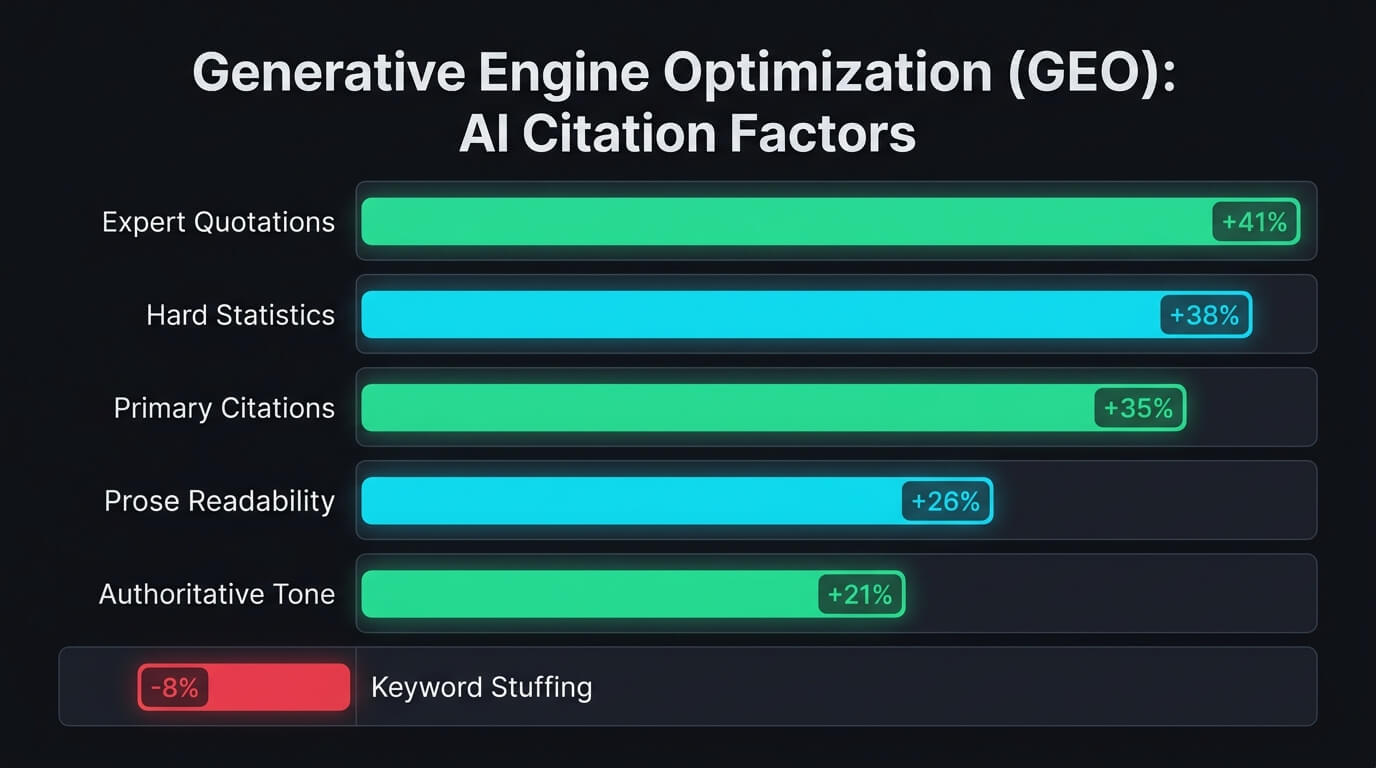
As traditional rank positions lose their monopoly on organic clicks, Generative Engine Optimization (GEO) has emerged as the definitive discipline of modern search marketing. In a landmark benchmark study conducted by researchers at Princeton University and Georgia Tech, scientists systematically evaluated which on-page optimization strategies improve citation visibility across generative engines (GEO-Bench / arXiv).
The findings dismantle many traditional SEO assumptions while reinforcing the necessity of high-integrity journalism:
- Expert Quotations (+41.0% Visibility): Integrating attributed quotes from verified industry specialists provided the single largest visibility boost in generative citations.
- Hard Statistics & Quantitative Data (+38.0% Visibility): Empirical figures, research data, and percentage metrics significantly elevate an article’s likelihood of being ingested into the LLM’s synthesized response.
- Primary Citations & Academic Footnotes (+35.0% Visibility): Transparently hyperlinking external primary sources signals rigorous topical research to semantic parsers (ACM SIGKDD).
- Prose Fluency & Readability (+26.0% Visibility): Writing clearly and concisely without superfluous jargon directly enhances machine summarization accuracy.
- Authoritative Tone (+21.0% Visibility): Decisive, expert-driven prose outperforms speculative or passive phrasing.
- The Keyword Stuffing Penalty (-8.0% Drop): Archaic keyword repetition techniques actively depress citation selection by 8%, triggering hallucination-prevention filters.
Key GEO Optimization Benchmarks
- FAQPage Schema markup increases generative citation selection rates by an average of 41.0%.
- Content written at an 8th-to-10th grade reading level captures 67.0% of all AI Overview citations.
- 44.2% of all generative citations originate from the first 30% of a webpage’s body text.
- Off-site brand mentions correlate with AI citation inclusion at a high 0.664 Pearson coefficient.
- Content updated within the trailing 30 days achieves a 3.2x higher citation multiplier.
The Shifting Search Landscape: Who Gets Cited in LLM Answers?
If Google isn’t linking to the top 10 organic results, who is getting the spotlight?
One of the most profound revelations of the 2026 search ecosystem is the dramatic decoupling of traditional rankings from AI citations. According to long-term tracking datasets, the overlap between pages ranking in the traditional organic top 10 and URLs cited in AI Overviews has plummeted from 76% in early trials to just 17% to 38% today (BrightEdge & Semrush).
Instead of regurgitating traditional SERP winners, Google’s retrieval-augmented generation models heavily favor platforms with authentic, user-generated experience (UGC) and authoritative earned media:
- Reddit (21.0% Citation Share): Reddit reigns as the single most cited domain in Google AI Overviews, commanding over a fifth of all source attributions (Surfer SEO).
- YouTube Transcripts (23.3% Citation Share): Google aggressively ingests video transcripts, making YouTube links and video timestamps a dominant citation source (DemandSage).
- Wikipedia (18.4% in Google vs 47.9% in ChatGPT): While OpenAI relies heavily on Wikipedia for nearly half its citations, Google has diversified its knowledge grounding across editorial web publications.
- Quora & LinkedIn (14.3% & 13.0%): Community-driven question threads and verified B2B thought leadership profiles receive preferential citation status.
- Earned Media Dominance (84.0% Share): Third-party editorial coverage, journalist mentions, and digital PR placements comprise 84% of corporate citations in AI search, completely overshadowing corporate blogs (Muck Rack).
Here is the silver lining for marketers: AI traffic is dramatically more valuable. Users who actually click through from an AI Overview citation convert at 4.4x the rate of standard organic visitors, while cited brands report an average +120% boost in overall organic click acquisition (Seer Interactive). Winning the AI citation is hard, but the payoff is substantial.
How Content Refresher Protects Your Traffic from Zero-Click Decay
Can your content afford to sit untouched for months in an AI-first search environment?
The single most actionable statistic in recent search research comes from cross-platform LLM monitors: content updated within the trailing 30 days earns a 3.2x higher citation frequency in Google AI Overviews compared to stagnant documents (ConvertMate & Presence AI). In an algorithmic world prioritizing freshness, velocity, and factual accuracy, content decay is no longer just a slow drift in rankings—it is an instantaneous ejection from the AI answer box.
Manually monitoring hundreds of historical blog posts for topical gaps, expired stats, and declining CTR is an operational nightmare for marketing teams. This is where Content Refresher transforms your workflow. Content Refresher is an intelligent WordPress automation plugin that automatically scans your published library, pinpoints posts suffering from content decay, and generates comprehensive, high-authority refresh drafts complete with updated data, structured schema, and enhanced readability.
Ready to take the next step?
Boost your rankings and stay ahead of the competition with AI-powered content refreshing.
Get StartedCrucially, Content Refresher operates with a strict “human-in-the-loop” architecture. While the system automates hours of data research, competitive gap analysis, and content synthesis, nothing is ever published without your explicit review and manual approval in the Verification Queue. You retain complete editorial control, customize rules by post age, category, or tag, and ensure every page on your site meets the strict freshness signals Google demands. Stop letting zero-click search cannibalize your hard-earned traffic—start your free trial with Content Refresher today.
Best Practices for Surviving and Winning in 2026
How do you translate these numbers into an unbeatable SEO roadmap?
Navigating the zero-click landscape requires a deliberate pivot from volume-based content production to citation-grade information architecture:
- Institute a 30-Day Content Refresh Cadence: Regularly update high-priority commercial and informational posts with new statistics, recent case studies, and refreshed publication dates to capture the 3.2x freshness multiplier.
- Front-Load Data in the First 30%: With 44.2% of AI citations originating from the opening third of a page, place your key findings, answers, and data summaries directly below the introductory heading.
- Implement FAQPage and Dataset Schema: Rich structured data increases machine readability and yields an empirical +41.0% increase in citation selection.
- Incorporate Expert Quotes & Empirical Research: Elevate every piece of content with verifiable third-party statistics and original expert quotes to trigger the +41% and +38% GEO visibility boosts.
- Invest in Digital PR & Community Presence: Because 84% of AI citations derive from earned media and community hubs like Reddit and LinkedIn, building brand resonance outside your owned domain is now a primary SEO ranking factor.
Conclusion
The era of treating Google as an infallible firehose of cheap referral traffic has come to a definitive end. With zero-click searches exceeding 68% and AI Overviews stripping 58% of clicks from the top organic position, publishers can no longer rely on superficial optimization tactics.
Yet, the search ecosystem is far from dead. By adapting to the principles of Generative Engine Optimization—grounding content in empirical statistics, embedding expert voices, maintaining ruthless freshness, and optimizing for citation value—you can capture the highly qualified, high-converting traffic that AI engines still pass through to the open web.
FAQs
Across search queries where an AI Overview is displayed, outbound clicks to the open web decrease by an average of 39.8%. Furthermore, the traditional #1 organic search ranking suffers an estimated 58.0% reduction in click-through rate when an AI summary appears at position zero.
The overall US zero-click search rate stands at 68.01%, meaning less than 36% of searches generate an outbound referral click. On search queries specifically featuring an AI Overview, the zero-click rate reaches 83.0%, and climbs to 93.0% within Google’s Conversational AI Mode.
According to benchmark research by Princeton University and Georgia Tech, the most effective factors for earning AI citations are: adding direct expert quotations (+41.0%), including hard statistics (+38.0%), providing source citations (+35.0%), and maintaining recently updated content within 30 days (3.2x multiplier). Conversely, keyword stuffing reduces visibility by -8.0%.
No. Studies by BrightEdge reveal that 83.0% of the domains cited inside Google AI Overviews do not rank within the top 10 traditional organic search results for that query. Generative engines prioritize freshness, authoritative citations, and concise semantic answers over legacy backlink authority.

With over 5 years of experience in Technical SEO and automation, Tomasz helps brands scale their organic traffic without scaling their headcount. Drawing from his experience in global tech projects like PhotoAiD, he specializes in Generative Engine Optimization (GEO) and building custom AI tools that eliminate repetitive work. He created Content Refresher to help founders put their content maintenance on autopilot.